
Celebrating America 250: How Motorsports Helped Shape a Nation

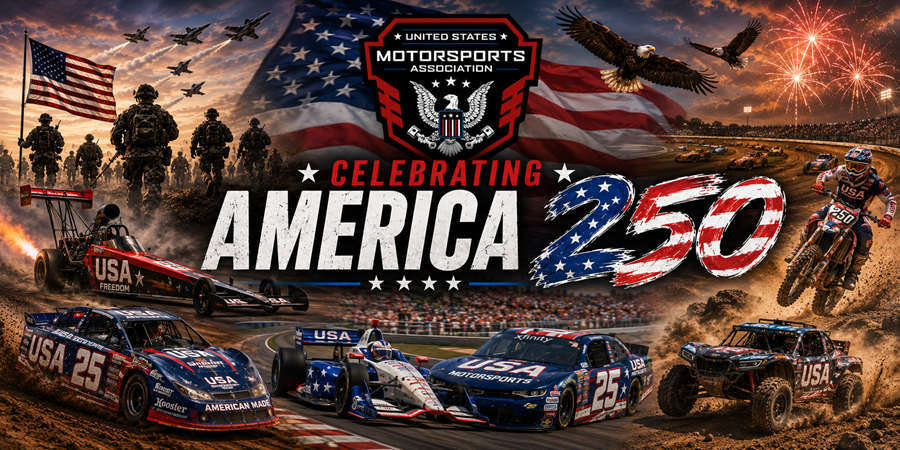
As the United States celebrates its 250th birthday, we reflect on the people, industries, and innovations that helped shape our nation. One of those enduring traditions is motorsports. For generations, racing has inspired innovation, strengthened local communities, created careers, and reflected one of America's defining characteristics: the desire to compete and continually improve.
While many point to the first Indianapolis 500 in 1911 as a defining moment, organized automobile racing in America actually began earlier. On Thanksgiving Day in 1895, six drivers lined up in Chicago for what is widely recognized as the first car race in the United States. The 54-mile course ran from Chicago to Evanston and back, through snow, mud, and brutal conditions. Only two cars finished. The winner, Frank Duryea, averaged just over 7 miles per hour, but his victory proved that the automobile was more than a novelty. It was the beginning of a new era.
That means motorsports have been part of over 50% of our nation's history. Few industries can say they have been woven into more than half of the American experience.
Competition has always been part of who we are. From horse racing in the nation's earliest years to bicycle racing, Americans have always looked for ways to go farther, faster, and push the limits of what was possible. When the automobile arrived at the end of the nineteenth century, racing quickly became part of its development and growth.
In October 1901, a young, unknown engineer named Henry Ford, whose first automobile company had failed, set out to prove both himself and his machine. He built a race car called the Sweepstakes and challenged Alexander Winton, the most famous driver in America at the time. Ford's upset victory captured national attention, restored investor confidence, and helped provide the financial backing that led to the Ford Motor Company.
More than sixty years later, Henry Ford II would again use racing to prove American engineering, this time on the world's biggest stage. Ford's victory over Ferrari at the 24 Hours of Le Mans became one of the greatest stories in racing history and showed that American innovation and determination could compete with anyone.
As automobiles transformed America, racing grew with them.
The Indianapolis Motor Speedway opened in 1909 as a place where manufacturers could test new ideas under extreme conditions. The Indianapolis 500 soon became one of the world's great sporting events. The Pikes Peak International Hill Climb followed in 1916, challenging drivers and engineers to conquer one of America's toughest mountains. Across the country, racing spread to dirt fairgrounds, beaches, dry lake beds, road courses, off-road deserts, and purpose-built speedways, creating a diverse motorsports culture unlike anywhere else in the world.
Like much of America, racing came to a halt during World War II. Drivers entered military service, race tracks closed, and manufacturers shifted to producing tanks, aircraft engines, and military vehicles. When the war ended, racing rebounded, and the country entered a new era of growth.
The post-war years launched the modern era of American racing. Returning veterans brought mechanical skills home, the automobile became part of everyday life, and hundreds of short tracks and drag strips opened across the country. Friday nights belonged to drag racing. Saturday nights belonged to dirt tracks. Sundays belonged to NASCAR, sports cars, motorcycles, and open-wheel racing. Local speedways became gathering places where families spent weekends together and future champions got their start.
As the sport expanded, so did its reach. NASCAR became America's premier stock car series. Southern California became the birthplace of organized drag racing through the NHRA. Sports car racing flourished across newly built road courses. Off-road racing found its home in the deserts of the American West, while American motocross champions helped establish the United States as a global leader on two wheels.
Race tracks became laboratories where engineers tested ideas that eventually improved the vehicles we drive every day. Advances in engines, brakes, tires, aerodynamics, lightweight materials, electronics, safety systems, and today's hybrid and electric technologies have all benefited from competition.
Motorsports also became an economic engine. The industry supports manufacturers, engineers, machinists, fabricators, skilled trades, marketers, hospitality professionals, and many thousands of small businesses. Today, the racing industry generates billions in economic activity and provides an important source of tourism and jobs, especially in rural communities across the country.
Like America itself, motorsports has faced adversity. World War II stopped racing. Nearly 80 years later, the COVID-19 pandemic did the same. Each time, racing endured. That resilience says something about the sport and its people. Americans have always found a way to rebuild, innovate, and move forward.
As we look toward America's next 250 years, motorsports will continue to evolve. Electric propulsion, sustainable fuels, artificial intelligence, and technologies yet to be imagined will shape the next generation of racing. Some believe those advances will change the sport beyond recognition. They probably will.
But history tells us something else. Every generation has raced different machines, adopted new technology, and pushed new limits. The vehicles will change. The technology will change. The desire to compete will not.
For more than a century, motorsports have reflected the qualities that helped build America: ingenuity, determination, entrepreneurship, craftsmanship, and optimism of the belief that, against long odds, we can win. In most sports, half the competitors go home winners and half go home losers. In racing, there is only one winner. Ninety-nine percent of the time you get on the racetrack, you will lose. Yet we continue to chase the challenge.
That is what Americans do.
As our nation celebrates 250 years of independence, motorsports deserves recognition not simply as entertainment or a fringe sport, but as an important part of the national story.
The next chapter has not yet been written. As Henry Ford once said, "The rearview mirror is always clearer than the front windshield." We may not know exactly what the future will look like, but we know where it begins.
Somewhere in America, a young dreamer is imagining something we never thought was possible. Somewhere, an engineer is designing the next idea, a fabricator is building it, and a racer is preparing to bring it to life.
That has been true for more than 130 years. There is every reason to believe it will remain true for America's next 250 years.
Happy Birthday, America!


